
1. Overview
Our Dual-Layer Wallet Architecture is designed to help clients extend their existing fiat wallet systems into the stablecoin and digital asset domain — securely, compliantly, and with minimal integration effort.
The system is composed of two core layers:
graph TD
%% Layer 1: Wallet Product Access Layer
subgraph Wallet Product Access Layer
A1[Wallet-as-a-Service APIs]
A2[SaaS Portal]
end
%% Layer 2: Wallet & Custody Technology Layer
subgraph Wallet & Custody Technology Layer
B1[Wallet Management & On-Chain AML]
B2[Security Architecture]
end
%% Connections
A1 --> B1
A1 --> B2
A2 --> B1
A2 --> B2
%% Styling similar to the provided diagram (dark theme with structured boxes)
classDef layer fill:#1c1b29,stroke:#6a5acd,stroke-width:1px,color:#ffffff;
classDef item fill:#2b2940,stroke:#8b7bff,stroke-width:1px,color:#ffffff;
%% Red highlight for the SaaS Portal
classDef highlight fill:#2b0000,stroke:#ff4d4d,stroke-width:2px,color:#ffdddd,font-weight:bold;
class A1,A2,B1,B2 item;
Layer 1 — Wallet Product Access Layer
Provides Wallet-as-a-Service APIs that allow clients to embed stablecoin functionality directly into their applications.
Clients can enable features such as:
- Fiat-to-stablecoin conversion (e.g., AUD → USDT/USDC)
- Balance query and transaction history retrieval
- Stablecoin payout and remittance
- White-label integration with existing fiat wallet UI
Layer 2 — Wallet & Custody Technology Layer
Delivers the secure and compliant infrastructure that powers the wallet APIs.
It includes:
- Wallet Management & On-Chain AML: automated screening, transaction monitoring, address risk scoring
- Security Architecture: MPC/HSM signing, immutable audit logs, WAF monitoring, and break-glass disaster recovery
This dual-layer structure ensures separation of customer experience from custody and compliance operations, enabling our clients to innovate faster while maintaining regulatory-grade safety.
2. Wallet Product Access Layer
2.1 Functional Overview
This layer exposes a set of RESTful APIs for integrating stablecoin functions into your existing platforms.
Integration modes include:
- Checkout Widget (Hosted Gateway) — ready-to-use purchase flow embedded in your app
- Full API Integration — direct API connection with complete UI customization
2.2 Sequence Flow
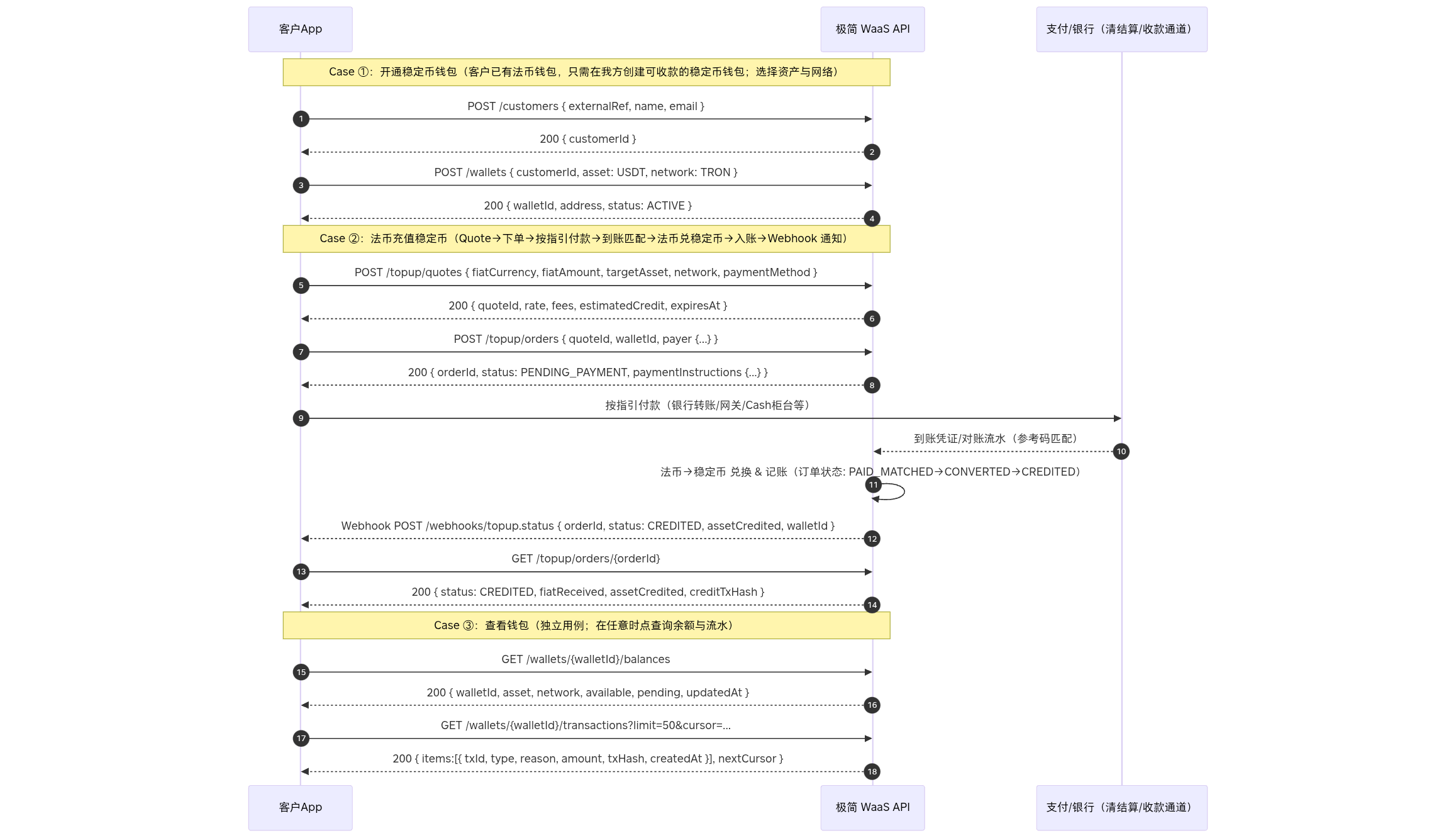
Below is an example of the API interaction for a typical “Fiat Deposit → Buy Stablecoin” on-ramp operation:
2.3 API Reference
Full API documentation and endpoint definitions are available here:

3. Wallet & Custody Technology Layer
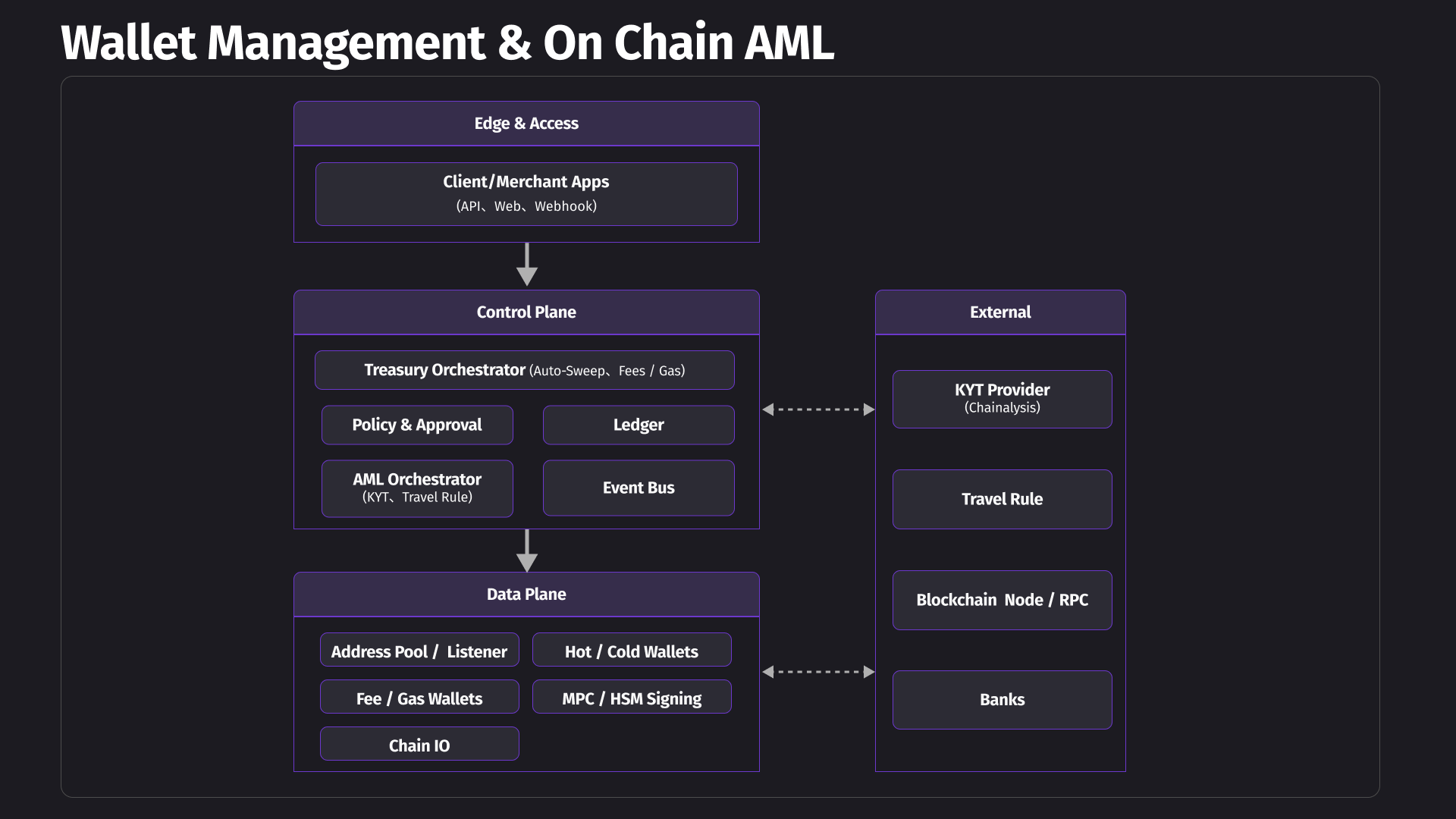
3.1 Wallet Management Architecture
3.1.1 Wallet Management
Our custody infrastructure is designed for reliability, scalability, and institutional-grade security.
- Hot Wallets: Protected by HSM (Hardware Security Modules) for physical isolation and tamper resistance, combined with MPC (Multi-Party Computation) to eliminate single points of key failure.
- Cold Wallets: Keys are stored offline, multi-party and multi-step access required for unlocking.
- Smart Treasury Orchestration: Automated management of gas fees, sweeping, and large-value transfers.
3.1.2 On-Chain AML Engine
Integrated compliance layer continuously monitors and evaluates transaction risks across all chains.
- Chainalysis KYT Integration: Real-time transaction screening and risk scoring.
- Travel Rule Compliance: Cross-institution data exchange aligned with regulatory standards.
3.2 Security Architecture
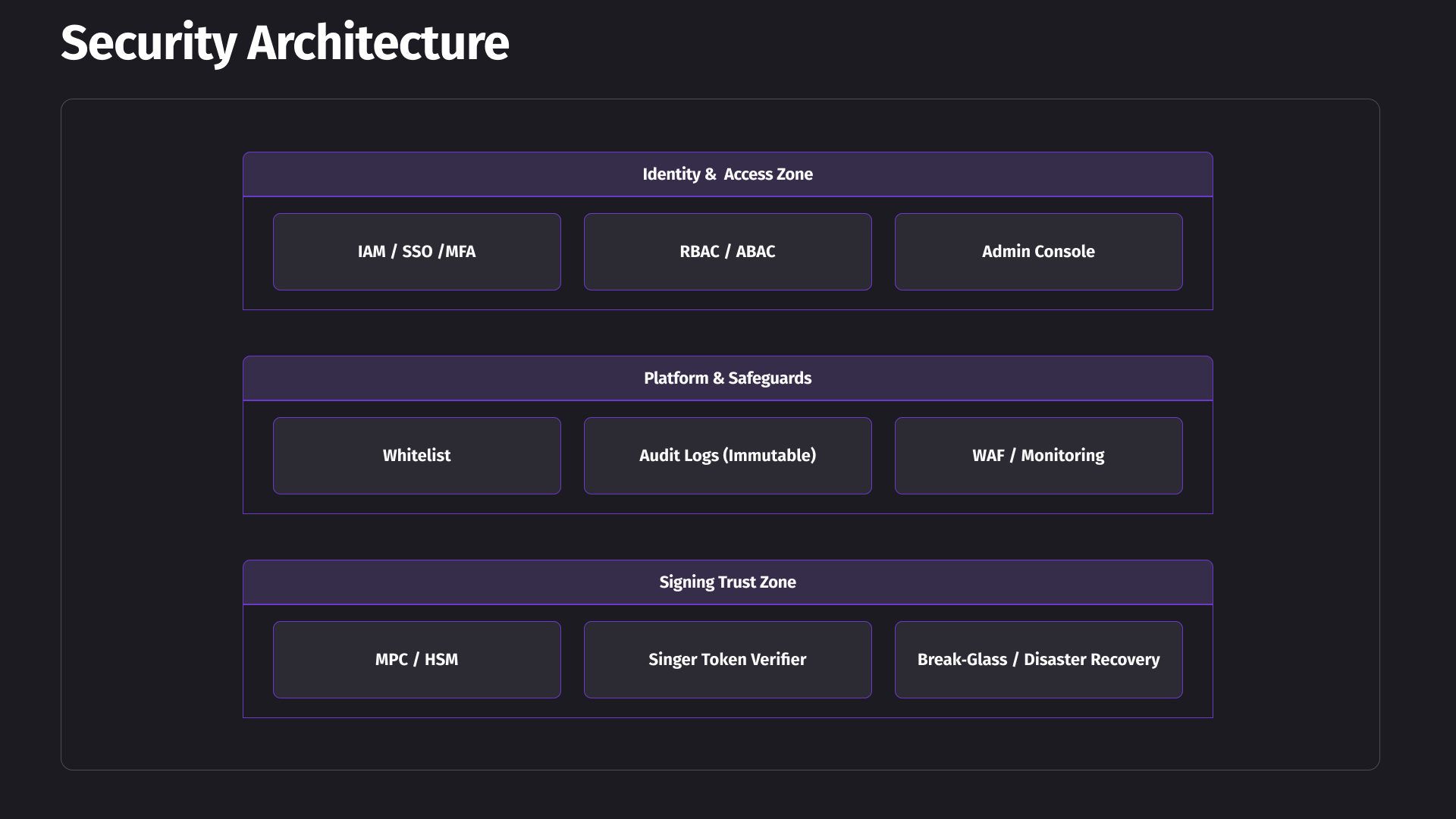
A three-zone defense framework ensures full lifecycle protection for wallet operations.
- MFA & Access Control: Multi-factor authentication and role-based permissions.
- Immutable Audit Logs: Permanent records for all sensitive administrative actions.
- Address Whitelisting: Enforced outbound security policy for wallet addresses.
4. Summary
The Dual-Layer Wallet Architecture offers:
- Simple API integration for stablecoin enablement
- Enterprise-grade custody and compliance infrastructure
- Scalable model to support future cross-border remittance, merchant settlement, and DeFi interaction